

 |
Beaminster Area ECO Group Thinking globally, acting locally Newsletter 50 : November 2024 |
Dear Friends
Big Green Day, 2024
What a successful and enjoyable day we had – isn’t it amazing how, when the sun shines, we see things much more positively! Located at the grounds of Beaminster School this year, we benefitted by having all the stalls and refreshments together, with seating in the middle, and music playing for much of the day – our thanks to Rough Assembly and Theo Slight for helping to create a ‘festival’ atmosphere. Again this year, Beaminster WI provided us with the amazing tea-shop, serving refreshments and homemade cakes, with scones, courstesy of The Wobbly Cottage. Thanks, too, to the Clipper Tea Caravan.
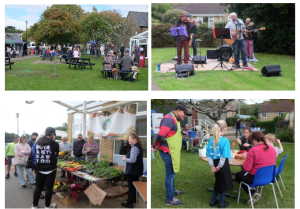
(All images ©Sheila Hawkins)
All funds raised will go into BAEG’s Community Fund to support local community projects.
On behalf of BAEG, I would extend thanks to Beaminster School, Beaminster Town Council, Nick David
and all who helped helped us in any way on the day. Thanks to all our stall holders, who provided such
interesting conversation, ideas and information, and lots of laughter.
And many thanks to all our sponsors: Beaminster Books, Clipper Teas Beaminster, Co-op Beaminster,
Evershot Bakery, Filberts of Dorset, Foxy Cottage of Stable Yard Broadwindsor, Fruit ‘N’ Two Veg
Beaminster, Isaac Cider, Larcombes Beaminster, Liberty Dairy Halstock, Little Groves Nursery Beaminster,
Salon on The Square Beaminster, Nick Tett Beaminster, The Fox Inn Corscombe, The Greyhound
Beaminster, WI Beaminster, and Wobbly Cottage, Broadwindsor.
BAEG Talks
In October we hosted a fascinating and informative talk on West Dorset Wilding’s Brit Valley Project. Nick Grey, a founding Trustee of the organisation, presented detailed information on the aims of this large- scale catchment-wide project on our doorstep, which encompasses 53 landowners across around 8,000 acres of landscape recovery aims, which has received central government (Defra) funding over its 20-year life cycle. This involves restoring some wildflower meadows, regenerative farming and natural methods of riverflow restoration. There was even talk of beaver re-introduction! West Dorset Wilding’s CEO Sam Rose answered questions, and both presenters engaged the large audience with their positive, inspiring and cheerful presentation.
Our next talk will be on
19 November 2024
Our thanks to Jenny Beck for the artwork on our talks posters.
Annual Members Meeting 2024
Following the above talk, we will hold our Annual Members Meeting. We look forward to seeing as many of you as possible there to support BAEG’s work going forward for the next year. We welcome your feedback on our programme of talks, Big Green Day etc, and your input and proposals for the 2025 programme.
2

Local Food Resilience
Candida Baker of Bridport Food Matters
building community, health, economic and environmental resilience – through food provision, activities, information and education
Tuesday 19th November 7 for 7.30
The Pavilion, Memorial Playing Fields, Beaminster free entry, but donations welcome! refreshments available
Beaminster Area Eco Group
thinking globally, acting locally


BAEG Committee members: Paul Rychnovsky, Robin Amswych, Nan Dower, Gillian Perrott, Deborah Childs, Rose Rychnovsky, Sheila Hawkins, Jenny Beck, Alison Roger.
Newsletter Editor: Sheila Hawkins, email: 11esgh528@gmail.com
Reflections on the year around Corscombe and beyond – Deborah Childs
My biggest disappointments this year have been the worrying lack of butterflies and no nesting swallows at our house. Two separate pairs of swallows arrived and looked as if they were going to build a nest in our garage, but sadly gave up and disappeared after a few days. However, one morning at the end of August whilst out for my daily dog walk, I was thrilled to see hundreds of swallows and martins flying overhead and swooping low over the field to stock up on flies which will provide them with some of the energy needed for their long journey south. At least I’m reassured that they have bred successfully in some parts of the UK.
In the spring I saw fewer numbers of orange tip butterflies than normal, despite having plenty of their caterpillar foodplant, lady’s smock (cuckoo flower), nearby. No doubt this was due to the prolonged wet and cold spring. In years past the buddleia shrubs in our garden have always been covered in butterflies: red admiral, peacock, comma, silver washed fritillary, and the lovely small tortoiseshell. Of the latter, I haven’t seen one this year while the others were in much smaller numbers. We can always hope that 2025 is kinder but my fear is that with no breeding females present this year their numbers will not recover.
On a happier note, my eldest daughter returning from a week in Pembrokeshire told me that she’d seen masses of butterflies on the coast paths including several wall butterflies. I’d seen one too in South Devon
in July at National Trust’s Coleton Fishacre, where I also saw a hornet mimic hoverfly. coloured chunky bodies these insects look at first glance much like our
European hornets; a deliberate ploy to frighten off any potential
predators. They obviously benefit from the sheltered valley and abundance of flowers because I’ve seen them at this site on previous visits.
With their brightly coloured chunky bodies these insects look at first glance much like our European hornets; a deliberate ploy to frighten off any potential predators. They obviously benefit from the sheltered valley and abundance of flowers because I’ve seen them at this site on previous visits.
Even more exciting later that day was being witness to a fabulous display by three peregrine falcons. Whilst in the gardens we could hear the birds calling and later when we’d walked down to the coast path below, we had a wonderful view of them flying quite low to the cliff face. It appeared that the adult pair were teaching the juvenile to hunt.
Out for a lovely walk on the chalk hills of the Dorset downs in September, Sheila and I had a similar experience, this time watching four kestrels, presumably 2 adults with their offspring. We also saw a red kite, a bird of prey which is rapidly becoming a much more familiar sight here in Dorset.
Still about birds, we have been lucky enough to have had regular visits to our feeders from siskins; at least one pair, so I’m hopeful that they have successfully bred. These are small passerines belonging to the finch family Fringillidae and seem here at least remarkably unworried about the presence of humans. I managed to get close enough to take a passable photograph of one with my phone camera.
My vegetable garden and polytunnel have really suffered this season from an abundance of slugs, despite having plenty of toads and at least one resident hedgehog. There have been times, I must admit, when I’ve been tempted to give up but happily the runner beans, tomatoes, courgettes, autumn raspberries, spinach and rocket flourished, so all is not lost.
Our honeybees too have had a difficult year: due to the cold and wet spring they were slow to get going and have only really had a couple of good weeks of sunshine throughout the whole summer when they’ve been able to take advantage of the nectar flows. Having made sure that we left plenty of food for the bees to use over the winter months we harvested the excess which is approximately half the amount we would normally expect. Local honey is going to be in short supply this season. On a brighter note, we have plenty of new queens to take the colonies into next year.
My husband, Chris, and I have recently invested in a bat detector, a wonderful piece of modern kit which fits onto a mobile phone and recognises the individual species by the ultrasonic sounds used in echo- location. So far, we have recorded here in our garden: – common pipistrelle, soprano pipistrelle, western barbastelle, noctule, Leisler’s noctule, common serotine and brown long-eared bat. Pretty impressive! On a recent visit to the grand Western Canal at Tiverton to see the historic horse drawn barge in action, (the only one of its kind in the UK), it was a lovely surprise to see three kingfishers flying low over the water not far from the town. The best place to spot them apparently, is further east near Sampford Peverell. Another day out to look forward to.
The days are drawing in and our garden birds are enjoying quieter times now that the breeding season is over. For the past few weeks, I’ve been enjoying regular sightings of warblers as they pass through on migration to Sub-Saharan Africa. I’m pretty sure they’re willow warblers- slender passerines with a marked pale eyestripe(supercilium) and often yellow tinged underparts. These little birds flit around in the trees searching for small insects and spiders though I understand that they will switch to fruit and berries at this time of year.
I am going to end with the exciting news that we had not one but two glow worms in our garden this summer. It was towards the end of June, and they glowed brightly for about 12 days before silently fading. I do hope they were discovered by a mate and with luck we’ll have even more in 2025.
BAEG Community Fund
The Beaminster Area Eco Group (BAEG) Community Fund’s first round for applications is open until 30 November 2024. The Community Fund currently available is £400. We invite applications in the range of £50 to £200. Information on the criteria and an application form to download are available on our website at: https://beaminstereco.wixsite.com/beaminstereco. Further information and assistance is available from, and completed applications should be sent to our email address at beaminstereco@gmail.com.
By providing small grants to local groups we hope to progress our aim of contributing to responsible stewardship of the world’s resources, and care for our local environment and its species.


Dates for the Diary
BAEG talks for autumn and winter
All talks are free and open to the public. They take place in the Pavilion at Beaminster Memorial Playing Fields and start at 7.30pm. Doors are open from 7.00pm with refreshments available.
Tuesday, 19 November 2024 – Local food resilience – Candida Baker from Bridport Food Matters;
followed by the BAEG Members Annual Meeting
2025
Tuesday, 14 January 2025 – The reintroduction of Falconry – Bill Pearson with his Goshawk
Tuesday, 11 February 2025 – Action Swift – Catherine Symonds of the Salisbury Swift Group
Tuesday, 11 March 2025 – Biodiversity in Quarries – Andy Littler
Tuesday, 8 April 2025 – What happens to our waste? – Dorset Waste Partnership
Tuesday, 13 May 2025 – Wild Flower identification – Netherbury Nature Group
BAEG Committee members: Paul Rychnovsky, Robin Amswych, Nan Dower, Gillian Perrott, Deborah Childs, Rose Rychnovsky, Sheila Hawkins, Jenny Beck, Alison Roger.
Newsletter Editor: Sheila Hawkins, email: 11esgh528@gmail.com